
THE NEW PRESIDENT OF SRI LANKA HAS VOWED TO INVESTIGATE THE 2019 EASTER SUNDAY BOMBINGS

“But let justice roll on like a river, righteousness like a never-failing stream!”

(Amos 5:24 NIV)
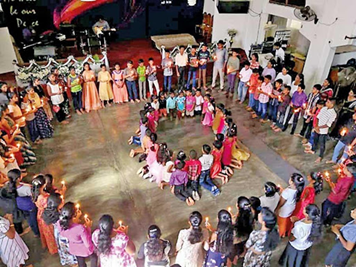


On Easter Sunday 2019, three churches and three luxury hotels in Sri Lanka were bombed in a series of coordinated attacks that claimed 279 lives. Despite investigations and civil lawsuits, the perpetrators of these attacks remain unidentified.

The Archbishop of Colombo, Cardinal Malcolm Ranjith, met with new President Anura Kumara Dissanayake and urged him to re-open investigations into this matter. On 6 October, President Dissanayake personally visited St. Sebastian’s Catholic Church in Negombo city, where 116 people were killed. The president pledged to the congregation that his government would conduct a fair and transparent investigation.

Subsequently, on 8 October, the government announced a new probe on the basis that previous investigations had failed to identify the culprits responsible for the country’s worst-ever attack against civilians.

The tragedy of these attacks is still deeply felt by many in the Christian community of Sri Lanka. At Zion Church in Batticaloa city, one bomb exploded just before the Easter service was to begin. At least 26 were killed and more than 100 were wounded. The 14-year-old son of Ganeshamoorthy Thirukumaran, a pastor at the church, were among 14 children and teenagers who died in the bombing.

Survivors of the attacks and their families continue to live with the trauma from these events and have persisted in demanding justice. The Catholic church has been at the forefront of this call for an independent investigation and the involvement of the international community. Father Cyril Gamini Fernando, head of the Communications Committee of the Archdiocese of Colombo, expressed the expectation that the new government would be taking action based on the findings of this new probe.

Overall, more than 500 people were wounded in the bombings, including 45 foreigners. Initially, officials blamed a local jihadist group connected with ISIS for the suicide bombings. However, many believe that there may also have been political motivations that allowed the attacks to take place.

Sri Lanka’s former intelligence chief, Suresh Sallay has been accused of involvement. Last year, the Supreme Court fined then-President Maithripala Sirisena and four senior government officials 310 million Sri Lankan rupees (approximately US$1.06 million) in a civil case for their failure to prevent the attacks.

In the meantime, Christians in Sri Lanka continue to face persecution at the hands of Buddhist and Hindu groups. One incident reportedly involved Buddhist groups throwing stones at a church in Kurunegala district, damaging the property. Local villagers also blocked the road leading to the church, preventing church members and the pastor from passing through. In 2023, 43 cases of intimidation and violence against pastors and their congregations were documented by the National Christian Evangelical Alliance of Sri Lanka (NCEASL), claiming that Buddhist groups obstructed worship services and were responsible for discriminatory actions and attacks on churches.


Home Group Prayer

Dear Lord,

We pray for our brothers and sisters in Christ living in Sri Lanka. We pray for your blessing and protection over them. Give them strength, faith, and hope in the face of persecution and allow them to live and worship freely and safely in their communities.

We also pray for the victims and families of the victims of the 2019 attacks. We ask that the new government of Sri Lanka will conduct a thorough investigation into these events in order that those responsible may be brought to justice.

We ask this in Jesus’ name.

Amen.

Sri Lanka: Continued harassment of Christians

SRI LANKA: Continued harassment of Christians and fears for the future

Christians in Sri Lanka have continued to face attacks in 2019. According to the National Christian Evangelical Alliance of Sri Lanka (NCEASL), there have been 83 recorded incidents in the country, including harassment by officials, abuse, and attacks.

In October, a Divisional Secretary, along with an officer of the Deniyaya police station, questioned a pastor about the legality of his church, the Hokma Bible Centre. They urged him to obtain authorisation from the Divisional Secretariat to conduct religious activities, even though the church has been operating at the location since 2007 and the pastor has valid papers for it. Until then, they demanded an immediate end to all services. They also insisted that they should be informed if any church is functioning in the area.

Attacks on Sri Lankan Christians came as Gotabaya Rajapaksa, the candidate representing Sri Lanka People’s Front, the Sinhalese-Buddhist nationalist party, won the presidential elections in November. This took place amidst some of the worst political instability and violence the country has seen.

In a speech soon after he was elected, Rajapaksa called for future cooperation: “Even though I knew I could win the presidential election with the support of the Sinhala people alone, I made a special request to Tamil and Muslim people to be partners in that victory. But their response was not to my expectation.” He continued, “But as your new president I ask you again to rally around me as true Sri Lankans for the sake of the future development of our country.” Sinhalese-Buddhist nationalists hope Rajapaksa will usher in another golden era for the nation’s ethnic majority.

“We built an ideology that the country needs a Sinhala leader who does not bend down in front of minorities,” claimed Galagoda Aththe Gnanasara, a monk and nationalist leader of Bodu Bala Sena (Army of Buddhist Power), a Sinhalese-Buddhist nationalist organisation responsible for several anti-Christian and anti-Muslim riots that went unchecked and is alleged to have the protection of the Rajapaksa government.

Many are justifiably worried about what Rajapaksa’s election will mean for religious harmony in Sri Lanka. Buddhist nationalism and violence against Christians have increased in recent years. Earlier this year, self-radicalised Islamist extremists bombed hotels and churches during the Easter Sunday attacks, killing more than 250 people.

HOME GROUP PRAYER

Heavenly Father,

We pray for your children in Sri Lanka. We pray that the new government will speak out and take action against those who persecute minorities and those of other faiths. We ask that acts of violence and harassment against our brothers and sisters in Christ in Sri Lanka end. We give thanks for the faith of our brothers and sisters in Sri Lanka who have continued to praise you and worship you and spread their faith in the face of persecution and harassment. We pray that those who preach hate against minorities and those of other faiths will be silenced and Sri Lanka can be a place of religious freedom and ethnic peace.

We remember the violence and destruction which took place in a terrible civil war and pray for the victims of that period and those who still suffer its consequences. We pray that we will each love our fellow human beings for you have created us all in your image.

May the Christian message of peace spread throughout all of Sri Lanka and the rest of Asia wherever Christians face persecution. We give thanks for your steadfast love which sustains us through all the difficulties we face in life. We pray that you will watch over our brothers and sisters in Sri Lanka who are doing your work and sharing your message for the benefit of all.

In Jesus’ name we pray. Amen.